If you’ve been dealing with sciatica and every time you try to stretch or exercise it makes things worse, you’re not doing anything wrong – you’re probably just doing the wrong movements. At Sitzmann Chiropractic in Lincolnton NC, this is one of the most common patterns we see. Sciatica has a mechanical cause, and certain popular stretches and exercises actually put more pressure on the exact structures already irritating your sciatic nerve. Knowing which movements to avoid, and which ones actually help, can make the difference between weeks of unnecessary suffering and real progress.
Why Some Stretches Make Sciatica Worse
The sciatic nerve is the largest nerve in your body. It exits from the lower spine, travels through the pelvis and buttock, and runs all the way down each leg. Sciatica happens when that nerve becomes compressed or irritated somewhere along its path – most commonly by a bulging disc in the lumbar spine, tightness in the piriformis muscle, or joint dysfunction in the pelvis.
The problem with many popular stretches is that they don’t distinguish between a tight muscle and an irritated nerve. Stretching a tight hamstring feels good and does what you’d expect. Stretching an inflamed nerve? That just pulls on the nerve harder, spreads the irritation, and can leave you significantly worse than when you started.
The rule of thumb: if a movement makes your leg pain worse or sends the pain further down your leg, stop doing it. That’s your nervous system telling you to back off.
Exercises to Avoid When You Have Sciatica
Deep Hamstring Stretches
Standing forward folds, seated toe touches, and any aggressive hamstring stretch is one of the most common ways people accidentally aggravate their sciatica. When you fold forward, you’re not just stretching the hamstring – you’re also tensioning the sciatic nerve along its entire path. If the nerve is already irritated, that tension amplifies the problem. Patients regularly come in saying their sciatica got worse after they started stretching to “loosen up.” This is usually why.
Heavy Squats and Deadlifts
These are excellent exercises for a healthy spine, but a bad idea during an active sciatic flare-up. The compressive load on the lumbar spine can push a bulging disc further against the nerve root. If lifting is important to you, sub in movements that maintain fitness without loading the spine while things calm down.
Toe Touches and Forward Folds
Same principle as deep hamstring stretches. Any movement that flexes the lumbar spine forward while lengthening the sciatic nerve tends to make things worse. If you feel shooting pain down your leg when you bend forward, that’s the exact movement pattern to avoid until the nerve has calmed down.
High-Impact Cardio
Running, jumping, and other high-impact activities send repeated compressive forces through the lumbar spine with every step. During an active sciatic flare, this often intensifies symptoms. Low-impact alternatives like walking, swimming, or stationary cycling are usually much better tolerated.
Sit-Ups and Traditional Crunches
These flex the lumbar spine forward under load – the exact mechanism that stresses lumbar discs. Even without a diagnosed disc problem, sit-ups can aggravate sciatica by increasing pressure on the nerve root. If you want to work your core, planks and dead bugs are much safer options.
Prolonged Sitting
Not an exercise, but worth mentioning because it’s one of the biggest daily contributors to sciatic pain. Sitting increases pressure on lumbar discs and shortens the hip flexors and piriformis, both of which can worsen nerve compression. If you have to sit for work, get up and move every 30 to 45 minutes.
What Actually Helps
Walking
One of the best things you can do for sciatica is walk. Not power walking, not hiking with a heavy pack – just steady, moderate-pace walking on flat ground. It maintains circulation, reduces stiffness, and keeps the spine in gentle motion without loading it. Most patients tolerate walking well even during flare-ups.
Piriformis Stretch (Done Correctly)
If your sciatica involves piriformis muscle tightness, a gentle piriformis stretch can help. Lie on your back, cross the affected leg over the opposite knee, and gently pull the uncrossed leg toward your chest. Hold for 20 to 30 seconds. Stop immediately if it increases leg pain.
Cat-Cow Movement
On hands and knees, gently arch and round your back through a comfortable range of motion. This mobilizes the spine without loading it and can help reduce muscle guarding. Keep the movement small and slow.
Pelvic Tilts
Lying on your back with knees bent, gently tilt your pelvis to flatten your lower back into the floor, then release. This is a small, controlled movement that reduces tension in the lumbar spine without adding compressive load.
Knee-to-Chest Stretch
Lying on your back, gently pull one knee toward your chest and hold for 20 to 30 seconds. Alternate legs. This can help relieve pressure on the lumbar spine and is generally well-tolerated by sciatica patients.
Why the Right Exercise Alone Isn’t a Fix
Even the safest, most appropriate exercises won’t resolve sciatica on their own if the underlying mechanical problem isn’t being addressed. Whether it’s a bulging disc, pelvic misalignment, or joint dysfunction in the lumbar spine, the source of the nerve compression has to be treated for the sciatica to actually resolve.
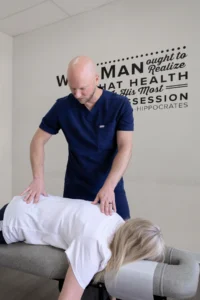
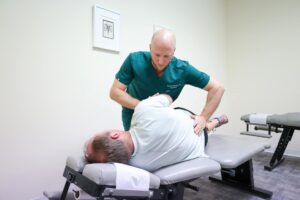
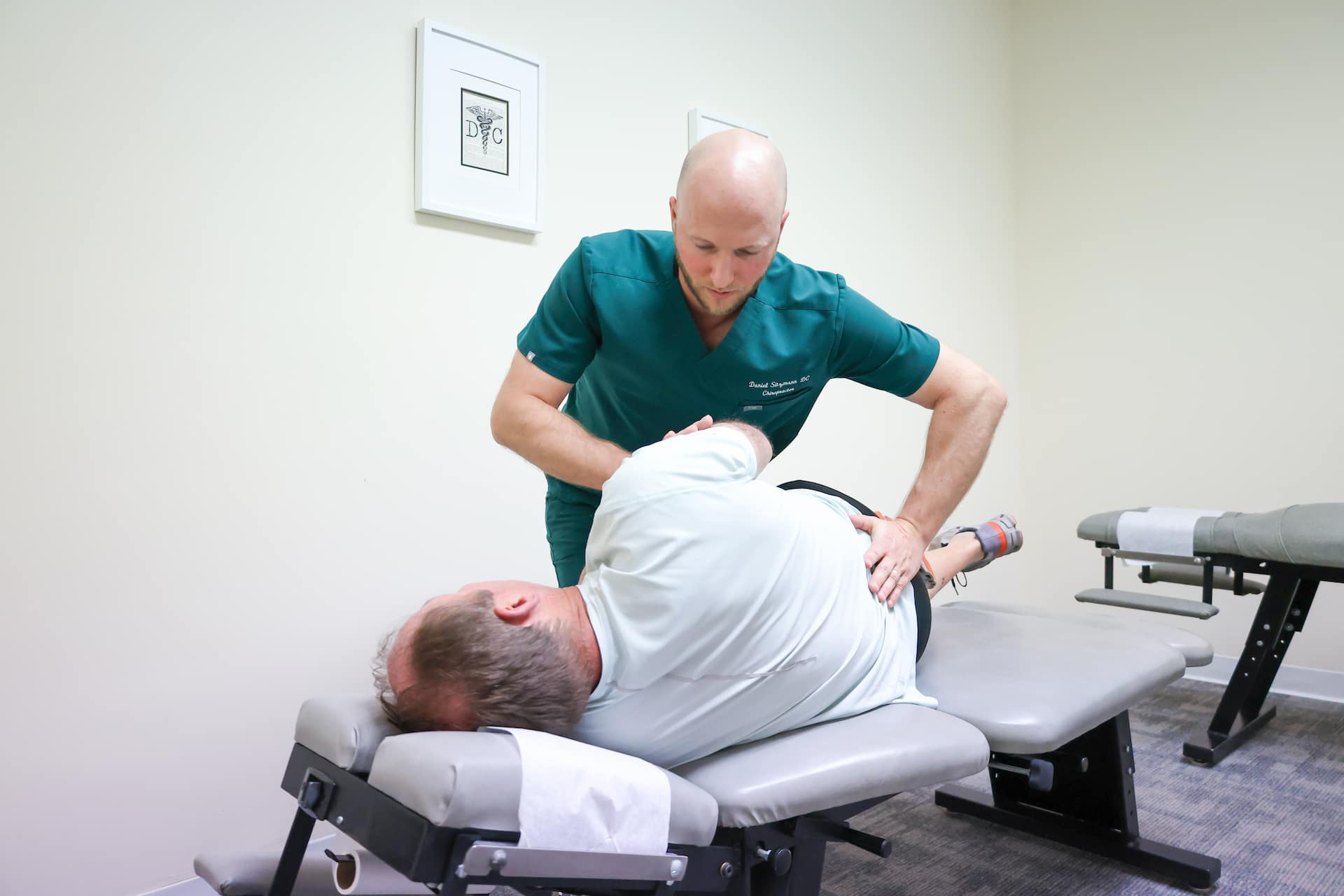
That’s where chiropractic care fits in. Adjustments restore proper alignment and joint motion, reduce pressure on the sciatic nerve, and give the surrounding muscles a chance to actually relax. Combined with the right movement approach at home, the sciatica typically improves significantly faster than either intervention alone.
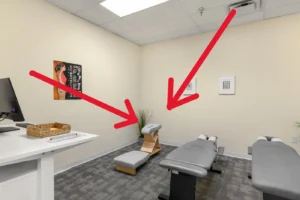
Every session at our Lincolnton office starts with our intersegmental traction table, which gently mobilizes the lumbar spine before the hands-on adjustment. You can read about our full session approach here.
When to Stop and Get Evaluated
Some sciatica situations warrant prompt evaluation rather than continued self-management. Loss of bowel or bladder control, progressive weakness in a leg that’s getting noticeably worse, numbness spreading rapidly, or pain that’s unrelenting and increasing rather than fluctuating – any of these should prompt medical evaluation right away. These are uncommon presentations, but they’re serious when they occur.
For the much more common situation – sciatic pain that fluctuates with activity, worsens with sitting, and responds partially to changes in position – chiropractic care is usually the right next step.
Frequently Asked Questions
How long should I avoid these exercises?
Until your sciatic symptoms have significantly reduced. For most patients, this is a few weeks of care. Once the nerve is no longer irritated, most of these movements can be reintroduced safely with proper technique.
Can I still work out during sciatica?
Yes, with modifications. Walking, swimming, stationary cycling, and gentle bodyweight movements are usually well-tolerated. Avoid anything that reproduces or worsens your leg pain.
Will stretching eventually help my sciatica?
Once the underlying nerve irritation has been addressed, targeted stretching and strengthening are important parts of long-term recovery. But during an active flare, stretching often makes things worse before it makes them better.
If sciatica has been keeping you from moving normally and self-management isn’t getting you anywhere, we can help you sort out what’s actually going on. Schedule online at our Lincolnton NC office or call us at (980) 284-2525.