If you’ve been diagnosed with a herniated disc and surgery has come up as an option, it’s worth slowing down before making that decision. For many patients in Lincolnton NC, chiropractic care produces meaningful relief from herniated disc symptoms without the risks, recovery time, or cost that come with surgery. That doesn’t mean surgery is never the right call – but it often shouldn’t be the first one.
What Actually Happens with a Herniated Disc
First, a quick clarification that matters: discs don’t “slip.” That term gets used a lot, but it’s not accurate. A spinal disc is firmly attached to the vertebrae above and below it. What actually happens is that the outer layer of the disc – called the annulus fibrosus – weakens or tears, allowing the soft inner material to push outward. That’s a herniation.
When the herniated disc material presses against a nearby nerve root, you get the symptoms most people associate with disc problems: sharp or burning pain, numbness, tingling, or weakness that radiates down an arm or leg depending on where in the spine the herniation is. The disc itself may or may not be painful – often the nerve irritation is the real driver of symptoms.
The good news is that disc herniations frequently improve on their own over time as the body reabsorbs the protruding material. The question is whether conservative care can manage symptoms well enough during that process, and whether it can help the spine heal in a better mechanical environment.
What Chiropractic Care Does for a Herniated Disc
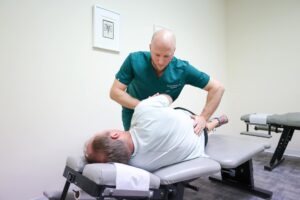
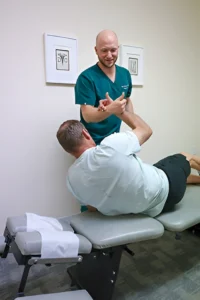
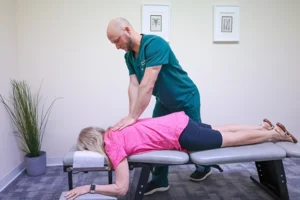
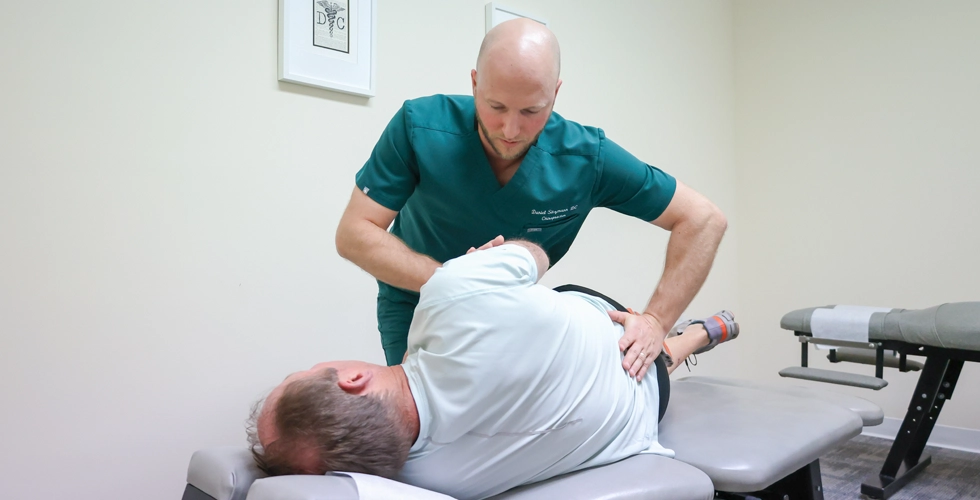
Chiropractic care for a herniated or bulging disc is not about forcefully pushing the disc back into place. That’s a misconception worth clearing up. What adjustments actually do is restore normal motion to the joints around the affected disc, reduce the muscle spasm that builds up in response to injury, and take pressure off the irritated nerve root by improving the overall mechanical environment of the spine.
When the vertebrae above and below a herniated disc are moving properly and not adding compressive load unevenly, the disc has a better chance of calming down and the surrounding inflammation has a better chance of resolving. Many patients see real improvement in their radiating pain, numbness, and function within a few weeks of consistent care.
At Sitzmann Chiropractic, every session begins with our intersegmental traction table – a gentle roller-style table that loosens the spine and reduces muscle tension before any hands-on adjustment. For disc patients who come in guarded and painful, that preparation step makes a real difference. Read more about our full approach here.
When Surgery May Be Necessary
I want to be straightforward here: there are situations where surgery is the right answer, and I’ll always tell a patient honestly if I think they’re in one of them.
The clearest surgical indications are what’s called cauda equina syndrome – loss of bowel or bladder control from severe spinal nerve compression – and progressive neurological deficit, meaning weakness that is actively getting worse rather than holding steady or improving. These situations require prompt medical attention and chiropractic care is not the appropriate first response.
Beyond those urgent cases, surgery is generally more appropriate when conservative care has been given a genuine trial – typically 6 to 12 weeks – and symptoms haven’t improved or have worsened. The key word is genuine. A few visits over a couple of weeks is not a full trial of conservative care.
What the Research Generally Shows
Studies comparing surgical and non-surgical outcomes for common disc herniations tend to find that many patients improve with either approach over time, with conservative care patients often reaching similar long-term outcomes to surgical patients – just through a different path. Surgery tends to produce faster short-term relief in some cases, but comes with surgical risks, recovery time, and in some cases the possibility of adjacent segment issues down the road.
That context doesn’t make surgery wrong. It makes an informed conversation with your healthcare team more important. If you haven’t yet tried a real course of conservative care, that conversation should include why not.
What to Expect if You Come In with a Disc Problem
The first visit at Sitzmann Chiropractic starts with a thorough assessment – not just of where it hurts, but of how your spine is moving, what’s restricted, and what the neurological picture looks like. If you have imaging like an MRI, bring it. It’s useful context, though it doesn’t replace a functional assessment.
From there, we’ll talk honestly about what we’re seeing, what we think chiropractic care can do for your specific situation, and what a realistic timeline looks like. If there’s anything in your presentation that suggests you need a different level of care, we’ll tell you and help you understand what that next step should be.
Many patients who come in having been told surgery was their only option find that a focused course of chiropractic care gets them to a place where they can function well without it. That’s not a guaranteed outcome – but it’s a realistic one that’s worth pursuing before committing to a surgical procedure.
Frequently Asked Questions
Can I see a chiropractor if I’ve already had back surgery?
In many cases, yes. Post-surgical chiropractic care is something we can discuss depending on what was done and how long ago. The approach is adapted to account for any structural changes from the surgery.
Is chiropractic adjustment safe if I have a confirmed herniation on MRI?
Generally yes, with appropriate technique. We adjust our approach based on the severity and location of the herniation. The goal is always to reduce nerve irritation and load on the disc, not add to it.
Should I wait until the pain gets worse before coming in?
No. Earlier is better with disc problems. The sooner we can address the mechanical environment around a herniation, the better the conditions for recovery. Waiting often allows secondary muscle spasm and compensation patterns to layer on top of the original problem.
If you’re dealing with disc pain and trying to figure out your next step, we’re happy to talk it through. Schedule online at our Lincolnton NC office or call us at (980) 284-2525.