
If you work at a desk and your neck is stiff by noon, your upper back aches by 3 PM, and you leave work feeling like your spine is 20 years older than you are, the problem isn’t weakness or bad luck. It’s a mechanical issue that builds slowly and predictably – and it’s something chiropractic care at our Lincolnton NC practice addresses regularly. The good news is that it responds well to treatment when you actually address the root cause instead of just stretching and hoping it goes away.
What Sitting at a Desk Does to Your Spine
The human spine was designed for movement. It handles compression, rotation, and load well when it’s moving regularly throughout the day. What it doesn’t handle well is being held in the same position for eight or nine hours straight – especially a position that most of us would have to admit isn’t that great to begin with.
When you sit at a desk, a few things tend to happen over time. Your head drifts forward toward the screen. Your shoulders round. Your lower back flattens out and loses its natural curve. None of these changes are dramatic on their own, but compounded over months and years of daily work, they produce real structural changes in how your spine loads and moves.
Forward Head Posture
This is the big one for desk workers. For every inch your head moves forward from its neutral position over your shoulders, the effective weight your neck muscles have to manage roughly doubles. A head that normally weighs about 10 to 12 pounds feels like 20 or 30 pounds to the cervical muscles when it’s sitting three inches forward. That constant overload produces stiffness, tension headaches, and eventually, joint degeneration in the upper cervical spine.
At our Lincolnton practice, forward head posture is something we see in a huge percentage of working adults. The pattern shows up on assessment before the patient even mentions their job. Addressing it is a core part of what we do for desk workers dealing with chronic neck pain.
Lumbar Flattening
Your lower back has a natural inward curve called a lordosis. That curve acts as a shock absorber and distributes spinal load efficiently. When you sit, especially without lumbar support or in a slumped position, that curve flattens. The discs in your lower back take on more compressive load than they’re designed for. The muscles along your spine work harder to compensate. Over time, this contributes to chronic lower back pain, disc problems, and stiffness that doesn’t fully resolve with a night of sleep.
Why Stretching Alone Isn’t Fixing It
Stretching helps. It’s worth doing. But it treats the symptom – muscle tightness – without addressing the underlying structural issue. If your cervical spine is misaligned and the joints aren’t moving properly, stretching the muscles around it gives you temporary relief but doesn’t change the mechanics. The tension comes back, usually within hours.
The same goes for ergonomic improvements. Getting a better chair or raising your monitor helps slow the progression of the problem. But if there’s already structural misalignment in your spine from years of desk work, ergonomics alone won’t correct it. That’s where chiropractic adjustments come in – restoring proper joint motion, reducing nerve irritation, and giving the surrounding muscles a chance to actually relax because the underlying alignment has been addressed.
What Chiropractic Care for Desk Workers Looks Like
When a desk worker comes in for the first time, the first thing I want to understand is their daily setup and routine. What does their workstation look like? How many hours are they seated? Do they have any movement built into their day? That context shapes the care plan.
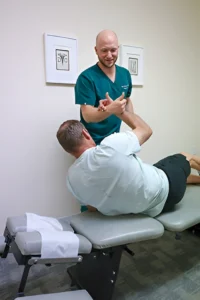
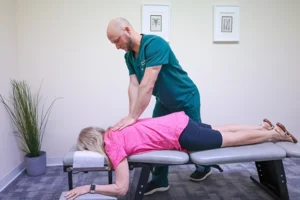
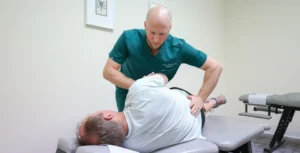
From there, we assess the spine – checking for misalignments, restricted joint motion, and muscle tension patterns. Desk workers typically present with issues in both the cervical spine (from forward head posture) and the lumbar spine (from prolonged sitting), so care often addresses both areas.
Every session at Sitzmann Chiropractic starts with the intersegmental traction table, which uses a gentle rolling motion to loosen and warm up the spine before the hands-on adjustment. Desk workers, who often come in tight and guarded from hours of sustained posture, tend to respond really well to this – it makes the adjustment more comfortable and more effective. You can read more about how we approach each visit.
I also talk with desk worker patients about habits they can build between sessions. Small things add up: setting a timer to stand and move every 45 minutes, being intentional about chin tucks to counteract forward head drift, checking in on shoulder position throughout the day. The adjustment does the structural work; the daily habits keep the gains from reversing between visits.
When Should a Desk Worker See a Chiropractor?
The honest answer is: before the pain gets bad. Most desk workers wait until the neck stiffness becomes constant or the lower back pain starts affecting sleep before they do anything about it. By that point, the pattern is usually well established and takes longer to correct.
If you’re noticing daily neck tension, headaches that seem to start in the base of your skull, or a lower back that stiffens up whenever you’re seated for more than an hour, those are early signals worth paying attention to. They’re the body telling you the mechanics are off before things escalate into something that requires more intensive care.
Walk-ins are always welcome at our Lincolnton NC office. If you work nearby or can come in on a lunch break, that’s a realistic option – our sessions are efficient and we work around busy schedules.
Frequently Asked Questions
Can chiropractic care help if I’ve had desk-related pain for years?
Yes, though longer-standing issues generally take more sessions to address than recent ones. We’ll be honest with you about what the timeline looks like based on what we find at your first visit.
Do I need to change my whole workstation before starting care?
No. We can work with whatever setup you have. Ergonomic adjustments help, and we can offer practical suggestions based on your situation – but they’re not a prerequisite to starting care.
What if my pain also goes into my arms or hands?
Arm and hand numbness or tingling from desk work often signals nerve involvement from cervical spine compression. That’s something we address directly, and it’s worth mentioning at your visit so we can assess it properly.
Desk-related neck and back pain doesn’t have to be the default condition of your workday. Schedule online at Sitzmann Chiropractic in Lincolnton, or call us at (980) 284-2525 to set up a visit.