
Most people who have never seen a chiropractor before have the same concern: they don’t know what’s going to happen. The sound they’ve heard about, the not knowing whether it will hurt, the wondering whether it will even work for their specific problem. If that’s you, this post is a straightforward walkthrough of exactly what your first visit at Sitzmann Chiropractic in Lincolnton, NC looks like, from the moment you walk in to when you walk out.
Before You Even Arrive
You don’t need a referral to see Dr. Daniel Sitzmann. Most patients schedule directly by calling the office or booking online. Walk-ins are also welcome. There’s no gatekeeping process, no mandatory imaging ordered in advance, and no forms so lengthy they require a coffee to get through.
Wear whatever you’re comfortable in. Jeans, athletic wear, work clothes, whatever you came from. You will not be asked to change into a gown. Chiropractic care at this practice is done with you fully clothed, which surprises a lot of first-time patients who were expecting a more clinical undress-and-wait experience. That’s not how it works here.
If you have any prior imaging, such as X-rays or an MRI related to the issue you’re coming in for, bring it along or let the office know it’s available. It’s not required for a first visit but it can be helpful context depending on what you’re dealing with.
Step One: The Conversation
Your first visit does not start with an adjustment. It starts with a conversation. Dr. Sitzmann wants to understand what’s going on before he does anything else, and that means actually talking through your situation rather than skimming a form and moving on.
He’ll ask about what’s bothering you, how long it’s been a problem, whether anything makes it better or worse, what your daily routine looks like, whether you’ve had any relevant injuries or prior treatment, and what you’re hoping to get out of care. That last question matters more than people expect. Someone who wants to be able to pick up their grandchildren without pain has different goals than someone who wants to get back to running. Understanding what a patient is working toward shapes the entire direction of the care plan.
This part of the visit takes real time. Dr. Sitzmann doesn’t rush through it. That conversation is one of the most useful diagnostic tools there is.
Step Two: The Examination
After the intake conversation comes a hands-on assessment. Dr. Sitzmann will evaluate your posture and spinal alignment visually, test your range of motion in the relevant areas, and palpate along the spine to feel for restriction, tension, and areas that aren’t moving the way they should.
He may also perform specific orthopedic or neurological tests depending on your symptoms. If you’re dealing with leg pain, numbness, or tingling, those tests help identify whether nerve involvement is part of the picture and where in the spine the issue is most likely coming from.
This isn’t a rushed, three-minute once-over. It’s a genuine assessment that informs everything about how your care is structured. By the end of the examination, Dr. Sitzmann will have a clear picture of what’s happening structurally and what the appropriate treatment approach looks like for your specific situation.
Step Three: The Traction Table
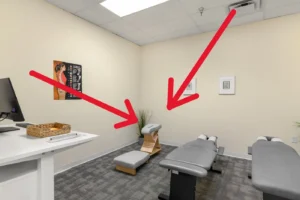
Before the adjustment, every session at Sitzmann Chiropractic begins with time on the intersegmental traction table. If you’ve never heard of this, here’s what it is: a table with a set of rollers that move slowly along the length of your spine while you lie on your back. It provides a gentle, rhythmic massage and decompression of the spinal segments from bottom to top.
Most patients describe this as surprisingly relaxing, especially on a first visit when they’re a little tense about the unknown. The traction table loosens the muscles and joints along the spine and prepares the vertebrae to respond better to the adjustment that follows. It’s one of the ways this practice differentiates itself from a quick in-and-out adjustment model.
You’ll spend several minutes on the traction table. Use that time to relax. It’s doing useful work.
Step Four: The Adjustment
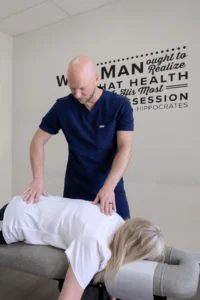
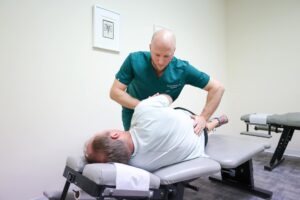
Here’s the part most first-time patients are most curious and most nervous about. The adjustment is the hands-on correction of restricted or misaligned spinal joints. Dr. Sitzmann applies a specific, controlled force to targeted vertebrae to restore proper movement and alignment to those segments.
You may hear a sound. That sound is just gas releasing from the joint space as pressure changes when the joint is moved, similar in mechanism to cracking your knuckles. It is not bones grinding, it is not something breaking, and the presence or absence of the sound doesn’t determine whether the adjustment worked. Some joints release audibly. Some don’t. Both are fine.
For most patients, the adjustment itself is not painful. It’s often described as a relief, particularly in areas that have been restricted and under tension. Some patients feel a brief moment of pressure at the adjusted segment. Very occasionally, someone with significant acute inflammation feels a bit of discomfort during the adjustment, but Dr. Sitzmann calibrates the technique to your comfort level and will check in throughout.
The adjustment targets the specific areas identified during your examination, not a generalized top-to-bottom protocol. Your care is built around what your spine actually needs, not a standard routine applied to every patient.
After the Adjustment: What You Might Feel
The most common experience immediately after a first adjustment is feeling noticeably lighter or looser in the treated area. Some patients feel an immediate reduction in the pain they came in with. Others notice the improvement more gradually over the following day or two as the inflammation settles and the muscles surrounding the adjusted joints begin to relax.
A small number of first-time patients experience some mild soreness in the treated areas for 24 to 48 hours after their first visit. This is completely normal and usually feels similar to the soreness after a good workout. It’s the body responding to joints being moved through ranges of motion they haven’t been accessing properly. It settles quickly and typically doesn’t recur after the first few visits as the spine adapts to care.
The Care Plan Conversation
Before you leave your first visit, Dr. Sitzmann will talk through what he found during the examination and what a realistic care plan looks like for your situation. This includes how frequently he recommends coming in initially, what the target outcomes are, and how the plan will be adjusted based on how you respond.
He won’t pressure you into a specific number of prepaid sessions or make you feel like you’re committing to something before you know whether it’s working. The plan evolves based on your progress. If you’re responding quickly, visits taper. If a particular area needs more attention, the focus adjusts. The goal is always to get you to a point where chiropractic is maintenance rather than crisis management.
You can read more about how the care model works on the Our Method page. If you have questions that didn’t get answered here, the FAQ page covers a lot of the most common ones.
Common First-Visit Questions Answered Honestly
How long will my first visit take?
Plan for around 45 minutes to an hour for your first visit. The conversation and examination take more time than follow-up visits, which are typically shorter once your care plan is established.
Will I need to come back multiple times?
For most conditions, yes. A single adjustment can provide temporary relief, but lasting improvement comes from consistent care over a period of time. How many visits depends entirely on what’s going on and how your body responds. Dr. Sitzmann will give you a realistic picture of what to expect after your first visit examination.
What conditions does Dr. Sitzmann treat?
The full list is on the conditions page, but the most common presentations are back pain, neck pain, sciatica, headaches and migraines, disc problems, scoliosis, joint pain, and TMJ dysfunction. If you’re not sure whether your issue is something chiropractic can help with, calling to ask is the fastest way to find out.
What if I’m nervous about the adjustment?
Tell Dr. Sitzmann. He adjusts his technique based on patient comfort, and there is no obligation to receive any part of care that you’re not comfortable with. First visits are about understanding your situation and beginning care at whatever pace makes sense for you.
Ready to Come In?
If you’ve been putting off seeing a chiropractor because you didn’t know what to expect, now you know. It starts with a real conversation, moves into a thorough examination, includes time on the traction table, and ends with an adjustment calibrated to your specific situation. No surprises, no pressure, no gowns.
Call Sitzmann Chiropractic in Lincolnton at (980) 284-2525 or schedule online to book your first appointment.