
If you find yourself twisting your neck or back at your desk to get that satisfying pop a few times a day, you’ve probably wondered whether it’s actually doing anything good – or whether you’re slowly making things worse. The honest answer is somewhere in between. At Sitzmann Chiropractic in Lincolnton NC, this question comes up constantly. Self-cracking isn’t dangerous in the way some people fear, but it’s also not the same as a chiropractic adjustment, and the urge to keep doing it is usually a signal that something else is going on.
What’s Actually Happening When You Crack Your Own Neck
That popping sound is called joint cavitation. Inside every joint in your body is a small amount of synovial fluid, which contains dissolved gases. When you stretch a joint quickly past its normal resting position, the pressure inside the joint capsule drops, and those dissolved gases form a bubble that pops audibly. That’s the crack.
It’s not your bones grinding together. It’s not anything moving back into place. It’s gas releasing under pressure. The sound itself is harmless and isn’t an indicator of whether anything beneficial actually happened.
After a cavitation, there’s typically a refractory period of about 20 to 30 minutes before the same joint can cavitate again. That’s why you can crack your neck and feel temporary relief, but then the urge comes back later – the joint has reset and is ready to do it again.
Self-Cracking vs. Chiropractic Adjustment
This is where the distinction matters most. When you crack your own neck, you’re applying general pressure to a region of your spine. Multiple joints might cavitate at once, including ones that didn’t actually need to move. The joints most likely to release are the ones that are already loose or hypermobile – which are often not the joints causing your stiffness in the first place.
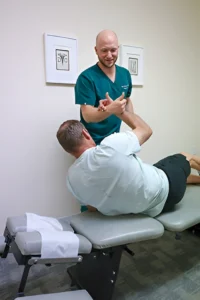
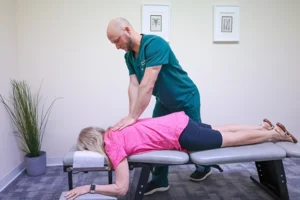
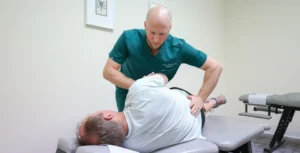
A chiropractic adjustment is the opposite. We identify which specific joint is restricted, where the actual dysfunction is, and apply a precise force in a specific direction to mobilize that particular segment. The restricted joint – the one that actually needed to move – is the one that gets adjusted. The hypermobile joints next to it are left alone.
That precision matters because over time, repeatedly cavitating the wrong joints can make them more loose while the truly restricted ones stay stuck. The end result is a spine with some segments that are hypermobile and unstable, and other segments that are still locked up causing the same original problem.
Why You Keep Wanting to Crack It
The urge to crack your neck or back isn’t random. It’s a signal from your nervous system that something in your spine isn’t moving the way it should. When a joint is restricted, the muscles around it tighten, and the nervous system registers a feeling of pressure or stiffness. Cavitating the area provides temporary relief – partly from the brief muscle relaxation that follows the pop, partly from the dopamine release that comes with the sensation – but it doesn’t address the underlying restriction.
That’s why the urge comes back. The cavitation gave you temporary relief, but the restricted joint still hasn’t moved. Within an hour or two, the tension builds back up, and you find yourself reaching to crack it again.
If you’re cracking your own neck several times a day every day, that’s a pretty clear sign of underlying joint dysfunction. The habit is your body telling you something needs attention. You can read more about chronic neck pain and stiffness at our practice.
Is It Actually Dangerous?
For most people, occasional self-cracking is not dangerous. The body has built-in mechanisms that prevent you from applying enough force to seriously injure your spine through normal self-manipulation. The popping sensation might feel dramatic, but the actual motion involved is well within the joint’s safe range.
That said, there are situations where it becomes risky. People who twist their neck violently can occasionally cause soft tissue strain, and in rare cases, more serious issues like vertebral artery injury have been documented from aggressive self-manipulation. People with existing disc problems, previous spinal injuries, or underlying joint conditions like rheumatoid arthritis should be more cautious about self-cracking.
The bigger issue isn’t acute injury – it’s what’s happening to your spine over months and years of repeated self-cracking when the underlying joint dysfunction never gets properly addressed.
What Repeated Self-Cracking Can Do Over Time
The two main long-term concerns are joint hypermobility and missed dysfunction.
Hypermobility happens when joints that don’t need to move are being moved repeatedly. The ligaments around those joints gradually stretch and lose their normal stability. The result is a joint that moves too much, which produces its own set of problems including chronic pain, muscle compensation, and increased susceptibility to injury.
Missed dysfunction is the other issue. The restricted joints causing your original stiffness keep getting bypassed because self-cracking doesn’t target them specifically. While you’re temporarily relieving the symptom, the actual problem progresses. Patients who come in after years of habitual self-cracking often have a combination of hypermobile segments and chronically restricted segments – a spine that’s both too loose and too stiff in different places.
What to Do If You’re a Habitual Self-Cracker
First, you don’t need to be hard on yourself about it. It’s an extremely common habit and most people don’t know what’s actually happening when they do it. The goal isn’t shame – it’s understanding why the urge is there and addressing the underlying cause.
The right step is an assessment to figure out where the actual restrictions are in your spine. From there, targeted adjustments can address those specific segments, the urge to self-crack typically reduces significantly within a few visits, and the hypermobile segments can be supported through care and movement work.
Every session at our Lincolnton practice starts with our intersegmental traction table, which gently mobilizes the spine and reduces the chronic tension that often drives the self-cracking habit. Read more about how our sessions work. For patients with chronic back pain or stiffness, that combination of preparation and targeted adjustment is often what finally breaks the cycle.
Frequently Asked Questions
Will my joints get bigger if I keep cracking them?
This is a common myth that’s been mostly disproven. Long-term studies have not found a strong link between knuckle or joint cracking and arthritis or visible joint enlargement. The concerns with self-cracking are more about hypermobility and missed dysfunction than about cosmetic changes to your joints.
Why does it feel so good when I crack my own neck?
The temporary muscle relaxation, brief mechanoreceptor stimulation, and small dopamine release that follow the pop all contribute to the satisfying feeling. It’s a real sensation – it just doesn’t last because the underlying issue hasn’t been addressed.
If I see a chiropractor, will I stop wanting to crack my own neck?
Most patients find the urge significantly decreases once the actual restricted joints are being properly addressed. The body stops sending the signal because the underlying restriction is being resolved.
If you’ve been cracking your own neck for years and the stiffness keeps coming back, your spine is telling you something. Schedule online at our Lincolnton NC office or call us at (980) 284-2525.