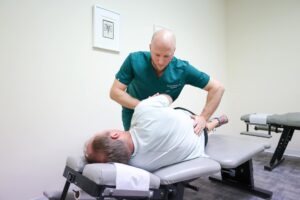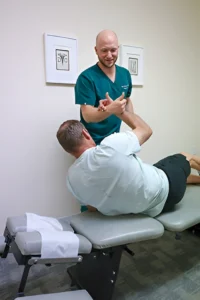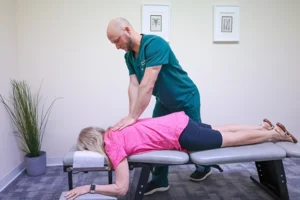
Most people think of chiropractors as back and neck specialists. But chiropractic care for joint pain in the shoulders, hips, and knees is something we address regularly at Sitzmann Chiropractic in Lincolnton NC – and for a lot of patients, it produces results that physical therapy and anti-inflammatories alone couldn’t. Joint dysfunction in the extremities often connects directly to how the spine is loading the rest of the body, which means treating the shoulder while ignoring the spine means you’re working on half the problem.
Why Extremity Joint Pain Often Connects Back to the Spine
The body operates as a connected mechanical system. When something is off in the spine – even something that isn’t producing pain yet – other joints downstream compensate. That compensation is the body trying to maintain function and keep you moving. But compensation comes at a cost. It loads joints in ways they weren’t designed for, and over time, that abnormal loading produces pain and dysfunction.
A misalignment in the lower lumbar spine or pelvis, for example, changes the way you walk. One hip hikes slightly. Weight distributes unevenly across the knees. The shoulder on the opposite side shifts to counterbalance. None of these changes are dramatic on their own, but sustained over months and years of daily movement, they wear down cartilage, irritate joint linings, and produce the kind of chronic aching that patients describe as “my bad knee” or “my problem shoulder.”
When we treat joint pain at our Lincolnton practice, we look at the full picture – not just the joint that hurts.
Shoulder Pain
The shoulder is one of the most mobile joints in the body, which also makes it one of the most vulnerable to dysfunction. Rotator cuff irritation, impingement, and frozen shoulder are common diagnoses – but the cervical spine plays a significant role in shoulder function that often goes unaddressed.
The nerves that control and supply the shoulder and arm originate in the cervical spine. When there’s compression or irritation at those nerve roots – from a misaligned vertebra or a disc problem – the result can show up as shoulder pain, weakness, or reduced range of motion. Adjusting the shoulder without addressing the cervical spine in these cases is treating the output, not the input.
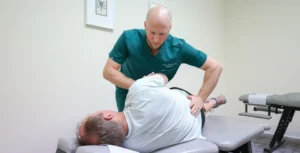
We also perform direct extremity adjustments to the shoulder joint itself when there’s restricted motion or local joint dysfunction. Restoring proper movement in the glenohumeral joint reduces impingement, takes stress off the rotator cuff tendons, and helps the surrounding muscles function without compensating. If neck pain accompanies your shoulder issues, the two are very likely connected.
Hip Pain
Hip pain is another area where spinal involvement is frequently the missing link. The sacroiliac joints – where the pelvis meets the lower spine – are among the most common sources of pain that patients label as “hip pain.” True hip joint dysfunction also occurs, but SI joint dysfunction is often the real culprit, especially when the pain is more in the back of the hip than the front or groin.
Chiropractic adjustments to the lumbar spine and pelvis directly address SI joint alignment. When the pelvis is level and moving symmetrically, the hip joints load more evenly, gait normalizes, and the chronic aching that builds up from asymmetrical movement patterns starts to resolve. You can read more about how we approach joint pain treatment at our Lincolnton practice.
Hip pain that radiates into the leg or produces a pattern similar to sciatica is worth evaluating carefully. Sometimes what feels like a hip problem is actually a sciatic nerve issue originating in the lumbar spine. Getting that distinction right changes the treatment approach significantly.
Knee Pain
Knees take a beating. They’re weight-bearing joints that absorb force from the ground up and load from the pelvis and spine down. When either side of that equation is off – uneven pelvic alignment above, foot and gait mechanics below – the knee pays the price.
Chiropractic care for knee pain often involves a combination of lumbar and pelvic adjustments to correct the load distribution from above, along with direct knee and lower extremity work to address local joint restriction. Patients who’ve been told their knee pain is “just arthritis” sometimes find that addressing the mechanical loading patterns that were accelerating the degeneration makes a meaningful difference in daily comfort and function – even when the structural wear and tear can’t be reversed.
If the knee pain is accompanied by lower back stiffness or hip tightness, those pieces are almost always connected and need to be addressed together.
What to Expect at Your First Joint Pain Visit
The first thing I do with any joint pain patient is take a thorough history – how long it’s been going on, what makes it worse, what you’ve already tried, and what your daily activity level looks like. Then we assess the whole system: the spine, the pelvis, and the affected joint. That full-picture assessment is what tells us where the treatment actually needs to happen.
Every session starts with our intersegmental traction table, which uses a gentle rolling motion to warm up and loosen the spine before any hands-on adjustment. For patients dealing with joint pain and significant muscle guarding, that preparation phase makes a real difference in how comfortable and effective the session is. Learn more about how our sessions work.
We’re also straightforward about when chiropractic care is the right fit and when a patient needs imaging, orthopedic evaluation, or a different kind of intervention. If something in your exam warrants a referral or a second opinion, we’ll tell you.
Frequently Asked Questions
Can chiropractic help joint pain caused by arthritis?
Chiropractic care doesn’t reverse arthritic changes, but it can improve joint mechanics, reduce the abnormal loading patterns that accelerate degeneration, and help manage the pain and stiffness that arthritis produces. Many patients with osteoarthritis in their knees or hips find regular chiropractic care meaningfully improves their daily function.
Do you treat both sides if both joints are painful?
Yes. Bilateral joint pain – both knees, both hips – is common and often indicates a central spinal or pelvic issue that’s loading both sides. We assess and treat accordingly.
Is extremity adjustment painful?
Most patients find it comfortable, and we always work within your tolerance. If there’s significant inflammation in a joint, we adjust our technique accordingly.
Shoulder, hip, and knee pain that has been hanging around doesn’t always need surgery or a lifetime of pain management. Sometimes it needs the right mechanical assessment and treatment. Schedule online at our Lincolnton NC office or call us at (980) 284-2525 to set up your first visit.